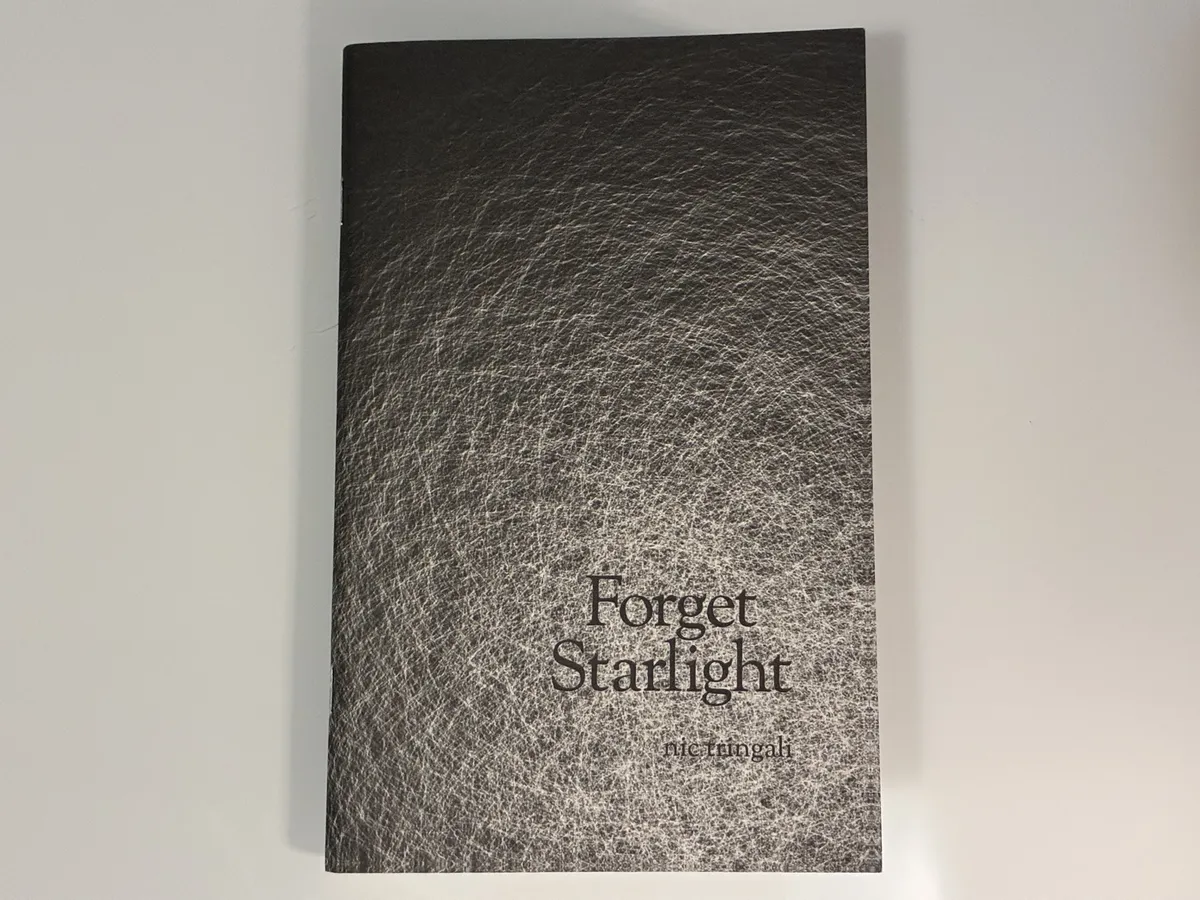
Forget Starlight is out
Forget Starlight is the first TTRPG I have written, and the first book my friend Matt / Dept. of Meteors has published. We're really proud of it! You can get in a print version or pdf-only version.
I might write more on the design specifics of the game but I think a overall design blog would be a fun thing to do even if I don't write more.
Forget Starlight was more accumulated than designed over the course of several years. I wanted to try my hand at TTRPG design since it's a space I am less familiar with and would be a fun way to stretch my brain. My first thought was a Mothership one-shot pamphlet which never really found purchase, even despite moderately successful playtests. I very rarely tend to use pre-written material when running games, I find the act of reading and preparing for it much more onerous than playing in a more improvisational style. I've gravitated towards games that facilitate that style, like classic Traveller and Troika!, which also involves the players in creating and interpreting the world alongside the GM.
Still with Mothership generally on my mind but without a clear goal I decided to make a d66 table of Mothership-y backgrounds and locations. I already felt this wouldn't be a Mothership thing but it was a good little ramp into something more interesting. Already to me this felt engaging—creating a truly random space without any kind of game or narrative influences really got my brain firing in narrative generation. Why would a Market be next to Automaton Storage, and both adjoined by a Garden? This arrangement won't make sense until the players make sense out of it. Or perhaps they won't! Humans construct weird spaces all the time.
The main problem as it stood now was that while generating spaces is momentarily fun, endlessly generating them quickly becomes stale. Players can create all kinds of reasons to explain or understand things, but they also don't have to. They can default to just moving on with play, or are simply tired. It's a not insignificant amount of work to create these kinds of narrative throughlines, especially when ideally the spaces feel lived in, with a history and future that the players are engaging in. This is where the pre-written adventure would slot in, but I don't really get on with those, so another tool is needed.
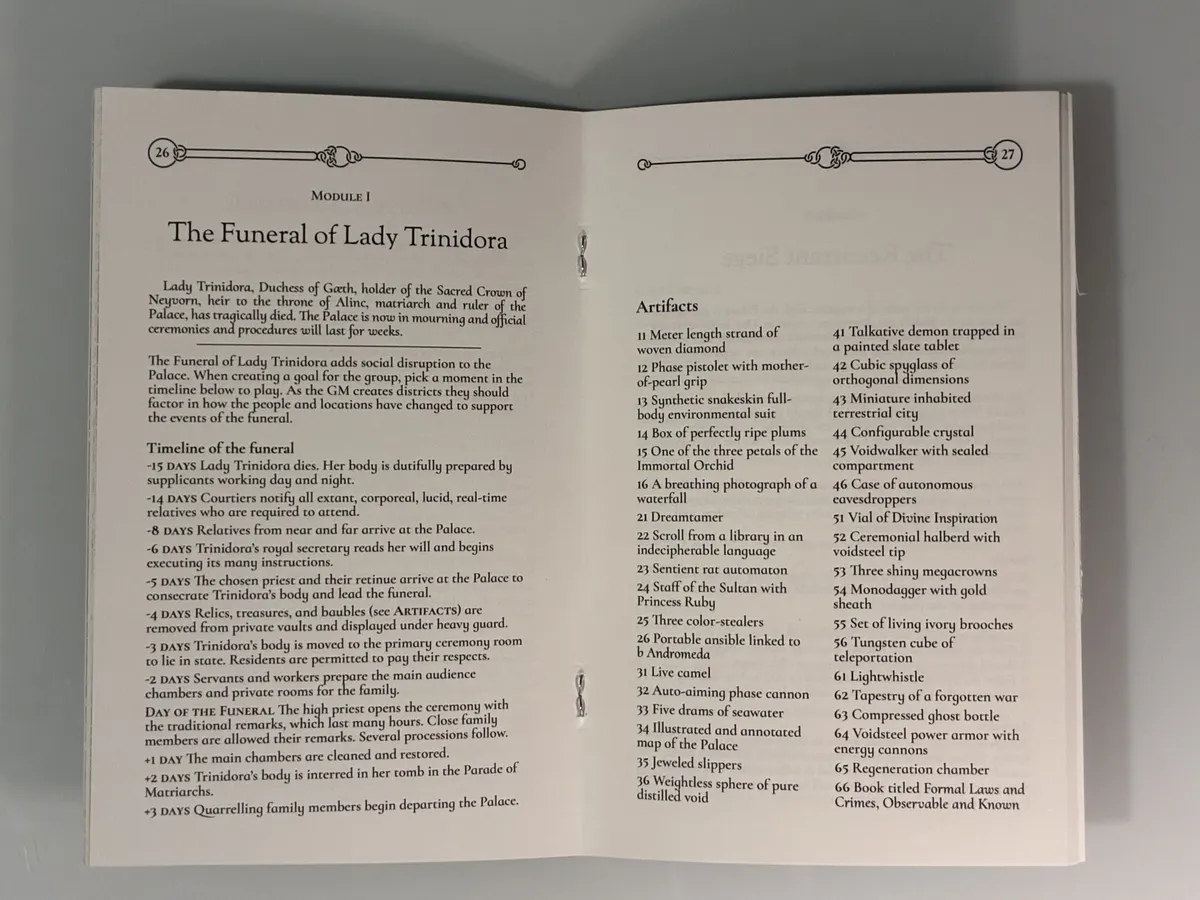
Forget Starlight's answer to this are modules, of which the game has three. Each module provides a toolbox to facilitate a specific social context that the spaces are subjected to: a royal funeral, a siege, or being outside of populated/civilized areas entirely. They each have a very light system contained within should players want it, but broadly what the module does is create a kind of 'default situation' for players to apply to spaces being generated. Our Market may be cleared away for a funeral procession, while the Garden is hosting a ritual, and Automaton Storage is locked away. The underlying reasons for those spaces being put together could still be explored, but those sit under the present goings-on of the funeral. Or perhaps the funeral is far away from these spaces entirely, but would still have ripples in effect here. The module gives players a structure that is orthogonal to the non-Euclidean physical spaces of the city and lets them draw connections or use as they will.
The rest of the design came together pretty much in service of having a very lightweight game system that supports this kind of play, where the players and GM are given a lot of random elements and assemble them into something coherent. Players give themselves a goal just a loose driving motivation, and are also tasked with creating their own map. There are stats and combat rules, and I think they are engaging and work well, but total about four pages out of fifty.
So that's Forget Starlight! I don't know if I will design more TTRPGs but it was incredibly fun and rewarding to design this one. I look forward to playing more and seeing the maps the non-cities that you make.